Jessica Davis
Thirteen Reasons WhyJessica Davis’s story is shaped by an intimate contradiction: she begins as one of Hannah Baker’s closest friends, becomes estranged from her, and later appears in the chain of events around Hannah’s assault without understanding the danger Hannah faces. Their friendship gives way to a physical confrontation at Monet’s, while the tapes reveal how Jessica’s own vulnerability, the silence of bystanders, and Hannah’s unrecognized pleas coexist in the same social world.
Identity and Introduction
Jessica first enters Hannah’s story through a classroom list. When Ms. Strumm takes the list away, Hannah looks across the room and sees Jessica Davis, angry and red-faced, with her pencil tapping rapidly against her notebook. Jessica’s name is in the column opposite Hannah’s. The list makes them visible to each other before they know one another, assigning them opposing categories and giving their eventual friendship a beginning marked by comparison and discomfort.
Their next connection is less adversarial. At school, Jessica is paired with Hannah through a buddy arrangement organized by Ms. Antilly. Both girls had expected a lecture about achievement and the school’s supposedly equal opportunities; instead, they are given a partner. The mismatch between the expected speech and the practical pairing turns an institutional exercise into the circumstance that brings them together.
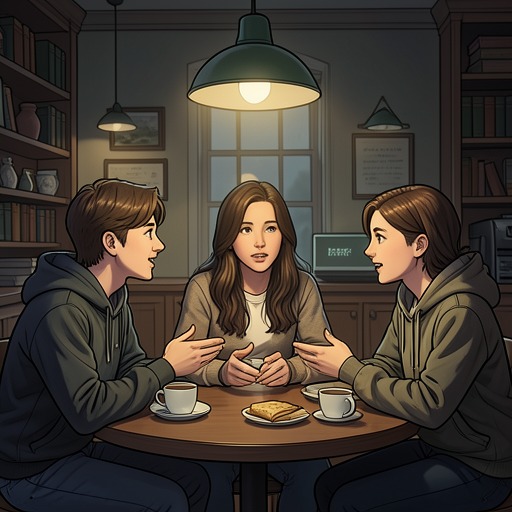
Jessica, Hannah, and Alex Standall later get to know one another at Monet’s. The café becomes an important setting in Hannah’s account of their friendship: it is where the three form a group, and later where Jessica and Hannah’s relationship breaks apart. The movement from classroom categories to shared conversation, and then to confrontation in the same social orbit, makes their friendship’s arc especially stark.
Friendship and Rupture
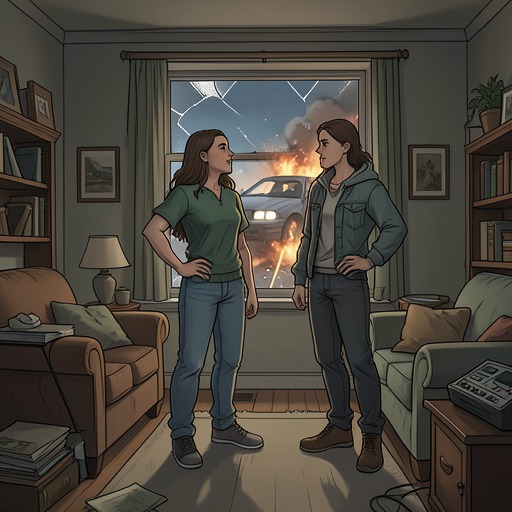
When Jessica approaches Hannah in the school halls and says, “We need to talk,” Hannah understands that she means Monet’s, though she is not certain why. Jessica is already sitting there when Hannah arrives, slumped in a chair with her arms dangling at her sides. Hannah imagines that Jessica may have been waiting a long time, perhaps hoping she would skip her last class to join her. The scene carries the residue of a relationship that still matters: Jessica has come to speak, and Hannah has come to meet her.
Their attempt to talk turns into a physical confrontation. Jessica rises beside her chair, glares down at Hannah, and swings. Hannah says she was lifting a hand and ducking when Jessica struck her; she cannot make out what Jessica called her. The episode is presented through Hannah’s retrospective address, which records the blow and its uncertainty without supplying a complete account of Jessica’s words or intentions. The distinction matters: the tape preserves Hannah’s experience of the attack, while leaving some of Jessica’s perspective unavailable.
The rupture grows from a painful misunderstanding. In Hannah’s account of the encounter with Marcus Cooley at Rosie’s, Marcus touches her while Zach Dempsey and other people nearby fail to intervene. Hannah’s distress is visible in her struggle to pry Marcus’s fingers away and in her efforts to catch someone’s eye. People glance over, then turn away; no one asks whether there is a problem. The episode becomes one of the experiences Hannah carries into her relationship with Jessica, and the tapes connect it to the moment when Jessica hears Hannah as accepting blame. Hannah’s account makes clear that being misread compounds the original injury: Jessica responds to what she thinks Hannah is saying, not to the meaning Hannah intends.
The Party and the Missed Intervention
Later, Hannah attends a party where Jessica and Justin Foley are sitting together on one end of a couch. Hannah and Clay Jensen sit at the other end and start talking. Hannah recognizes the pair but does not say their names. The sight of Jessica with Justin brings together several strands of her past: Justin was the boy Hannah first kissed, and Jessica was the girl who struck her at Monet’s. Their presence makes Hannah feel that she cannot escape what has already happened, even as she begins a new conversation with Clay.
After Clay leaves, Jessica and Justin stumble toward a bedroom. Hannah first thinks Jessica may be pretending to be drunk, bumping into her so that Hannah and Clay will get up and leave; she realizes that Jessica is genuinely very drunk. Hannah later says she did not see the couple enter the room, because she was on the floor against the far side of the bed and it was dark. These details limit what Hannah claims to have witnessed while establishing Jessica’s incapacitated state at the party.
Justin is outside the bedroom door when Hannah gets up and begins moving toward the strip of light beneath it. She sees another pair of shoes arrive and stops. The door opens and closes again; Justin jokes that Jessica will not move and will just lie there. The other man tells Justin he is working the night shift and has to leave soon. Hannah identifies this man as Bryce Walker. Justin steps aside, allowing Bryce into the room. Jessica is not described as participating in this exchange; the account presents her as too drunk to respond, while the men’s words and actions determine what happens next.
The tapes do not treat the failure as a simple question of whether Justin alone is responsible. Hannah tells him that either he or she could have stopped what followed, and that both of them let her down. She acknowledges that he tried to come to her rescue at another point, but asks why someone who discovers that a person cannot be reached would later use that failed rescue against them. Jessica’s place in these scenes is different: she is not shown making a choice at the door, but her drunkenness and inability to intervene form part of the circumstances that leave Hannah exposed.
Trauma, Recognition, and Aftermath
At a later party, Hannah and Bryce are together in a room. Hannah recounts that she did not say no or push his hand away; she turned her head, clenched her teeth, and fought back tears. Bryce saw her distress and told her to relax. Hannah’s account distinguishes her visible response from consent: she describes freezing and crying rather than actively resisting, and says she never told him to get away. This testimony should not be confused with Jessica’s own knowledge. Jessica is not shown witnessing the assault or receiving this account at the time.
When Hannah speaks with Mr. Porter afterward, he asks whether anything happened that could be considered illegal. Hannah answers that she does not think it was rape, then asks why she does not know. Mr. Porter offers two options: they can confront Bryce and discuss what happened at the party, or Hannah can move on. The exchange reveals Hannah’s uncertainty and the narrow terms of the response she receives; it does not establish what Jessica knows or what she might have done had she understood the full situation.
Jessica’s later presence at another gathering underscores how the relationships continue beyond the break. Clay and Hannah sit down and begin talking while Jessica and Justin occupy the other end of the couch. Hannah remembers her first kiss with Justin and then remembers how he ruined it; when Clay draws close, she tells him to stop, and her hands stop pulling him in. The recollection gives the moment an immediate emotional consequence: Hannah interrupts the intimacy and pushes Clay away. Jessica remains part of the tableau that summons this history, though Hannah does not speak to her there.
Narrative Role and Significance
Jessica’s characterization is conveyed largely through Hannah’s tapes, so the reader encounters her through a narrator who is both personally wounded by her and attentive to the wider pattern of harm and non-intervention. The tapes record Jessica’s visible anger in class, her effort to meet Hannah at Monet’s, the swing that ends their friendship, and her later vulnerability at the party. They do not provide a sustained account from Jessica herself. That limitation leaves room for neither an invented explanation nor a simple verdict: the narrative shows what Hannah experienced and remembers, while withholding Jessica’s full understanding of those events.
The contrast between the girls’ early connection and later estrangement gives Jessica a particular importance in Hannah’s account. They were brought together through a school buddy arrangement and became friends with Alex at Monet’s; then a moment of painful misinterpretation led to a blow and a lasting divide. In the party sequence, their histories remain present even without conversation: Hannah sees Jessica beside Justin and is pulled back toward memories of the first kiss and the later rupture. The past is not merely recalled; it changes how Hannah experiences the people in the room.
Jessica’s role also complicates the book’s treatment of intervention. At Rosie’s, Hannah’s attempts to signal distress are met by people who look away. At the party, Justin has a chance to stop Bryce and does not. Jessica, meanwhile, is too drunk to act in the bedroom sequence, and the text does not claim that she knew what was happening. These are distinct situations, not interchangeable forms of responsibility. By keeping those differences visible, Hannah’s account makes the broader pattern sharper: people may be present, connected, or even once close, yet still fail to recognize or answer another person’s need when it matters.